Weekly musings on the arts and current events.

Saturday, October 29, 2011

Night of the Living Chocolates


Sometimes we fly into the maw of our fears. On Halloween, we masquerade as demons. At the movies, we cry "Bring it" to those that would frighten us. And then there's trick-or-treating, when we let children forget everything we've taught them about candy from strangers.

The story of Hansel and Gretel is for a different time of year. The gingerbread home, bedecked with chocolates, sugared fruits, marzipan, and penny candies, wherein resides a cannibalistic witch, is a fine cautionary, but not for the night of October 31st. On All Hallows Eve, the kids walk right up and ring the bell, take whatever treats are offered, and soap the windows of old fools who won't come to the door.

Of course, each year the urban legends are rehearsed: razor blades in apples, maraschino cherries laced with LSD, and now, perhaps, counterfeit candy from China sweetened with anti-freeze (I made that one up). Even though the stories never pan out, they belong to the scary lore of Halloween. My uncle used to say he was going to pass out plastic bags to the kids, but he never did it.

I've saved up quarters this year in lieu of treats as I no longer allow chocolate into the house. I've also refused an invitation to watch football Monday night because I feel it's my duty to be home when the wandering sprites and neighboring goblins come to call.

Peddlers are extinct. Door to door Christmas Caroling has all but died out in the cities. Halloween is the only time I can think of when a stranger's knock is a welcome event. I wouldn't miss it for the world.


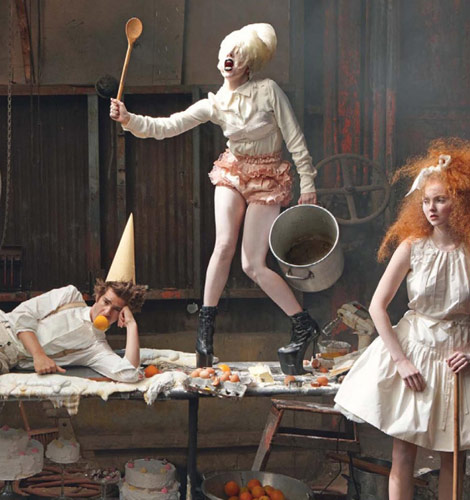
Hansel and Gretel in a scene staged by Grace Coddington and photographed by Annie Leibovitz for Vogue, 2009. The witch is Lady Gaga whose excellent duet with Tony Bennett, The Lady is a Tramp, was released this month. Click on the picture for a closer look, and Happy Halloween.

Saturday, October 22, 2011

No posting this week.

Please come back next week for a Halloween posting.

Saturday, October 15, 2011

Burning Issues


Religion rears its ugly head. In Egypt, Muslims have attacked Coptic Christians. And when the latter demonstrated peacefully in protest, elements of Egypt's military regime attacked them again. In Libya, a Jew returning from twenty years of exile to restore a synagogue, was assaulted and driven back into exile. The Arab Spring, with its hoped for flowering of democracy, is fast descending into an orgy of intolerance.

In America, the Perry campaign has kicked over a rock. Governor Rick Perry is the most overtly Evangelical of the candidates and his supporters have been pounding the pulpits. Mrs. Perry disingenuously deflected criticism of his poor debate performances by claiming he'd been "brutalized" for his faith. Worse still was a Perry camp bigot, Robert Jeffress, who attacked Governor Mitt Romney's Mormon faith as an unchristian cult. The remarks of neither have been repudiated by the candidate.

There remains the controversy over whether America is a Christian country. It is an argument that will never be resolved and won't go away. People are free to vote by any criterion they choose, and there will always be candidates who appeal to religious affinity. But publicly avowing that only a Christian is qualified to lead this nation is bitterly offensive to any who value the Constitution's unique contribution to history.

However, we can not deny that religion has a role. It does no good to weigh the brutality and injustice that it has caused through the ages because we can not fairly assess the good that faith has done, and still does, everyday. In Egypt, some of those who tried to protect the Coptic Christians in the streets were Muslims. And those of us who support Israel as a Jewish state, even though we may be secularists, do so because it is unrealistic to think the rights of Jews in that region would be respected in any other way.

Let us pray for the day when religion once again becomes a private matter between individuals and their Creator.

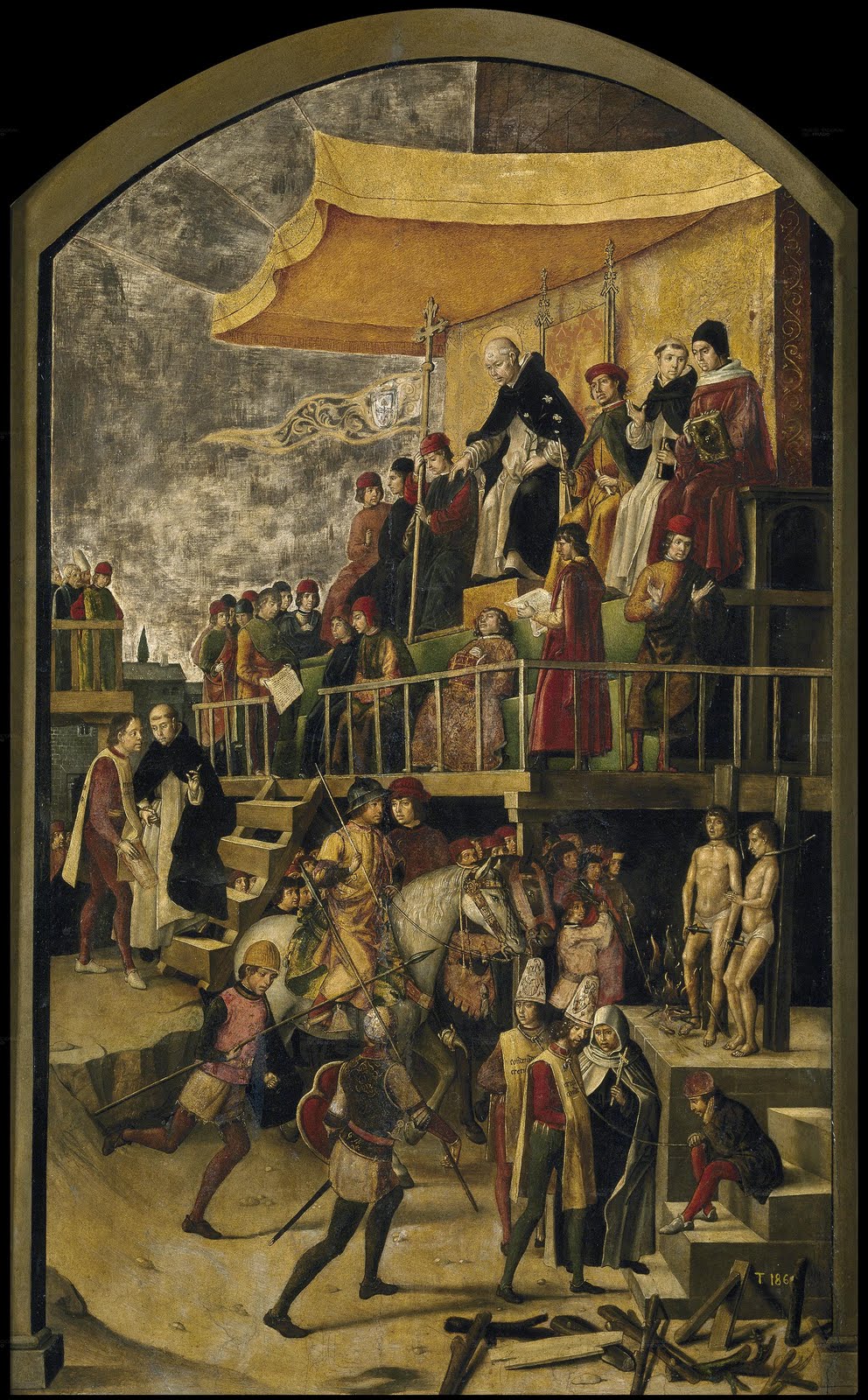
Saint Dominic Presiding Over an Auto De Fe by Pedro Berruguete, 1475. The scene is slightly anachronistic since Dominic died ten years before the Inquisition began. However the order he founded, the Dominicans, was put in charge of the slaughter in Spain, and besides, Dominic murdered many a heretic in France in his time. It's my opinion that the Inquisition depleted Spanish culture permanently, consuming it with hatred while the rest of Europe was engaged in the Renaissance. Click on the picture for a closer look.

Saturday, October 8, 2011

Two Wars, One Struggle

Occupy Wall Street continues and is spreading to other cities. The press has elevated it from a local act of civil disobedience to an inchoate national movement. Pundits now wonder aloud if this isn't the start of a force to countermand the Tea Party. Older pundits have likened the current protest's style and ambiance to that of Viet Nam era demonstrations at their naughtiest, with counter-culture exhibitionists hogging the spotlight but speaking gibberish in front of microphones.

It all feels much too familiar.

I've attended Tea Party rallies and been struck by the number of senior citizens who apparently haven't considered the implications of their fiscal demands vis a vis their Medicare and Social Security payments. Many have a strong religious and rural orientation and seem to identify the liberal policies they condemn with the depravities of urban life. In other words, the Tea Party wages the latest assault in the cultural warfare that has riven America since the 1960's.

The Occupy Wall Street movement, on the other hand, strikes a blow for class warfare. America is drifting dangerously toward plutocracy as the discrepancy between rich and poor, and the disappearance of those in the middle, makes our country look more and more like pre-revolutionary France.

I'm not the first to observe that the class warriors and the cultural warriors have much more in common than they care to admit. Both sides sound the alarm that middle class life in America is grievously threatened. Both demand justice and accountability. If only they could speak to each other without shibboleths and slogans. If only they didn't look at compromise and bipartisanship as perfidy. If only they didn't drag in social issues.

If only they haven't hated each other for years.


Hair lithograph, 1968. The musical was aptly named: "The American Tribal Love-Rock Musical". For a decade, reproductions of this crude image on posters and record albums, with the green print on a green field, were ubiquitous. But the play never rose above maudlin in addressing the Viet Nam War, while it smugly edified its tribe, i.e. the youthful audience. The revived show that opened in 2009, I've heard, emphasizes the characters' adolescent angst over their social rebellion. Click on the picture for a closer look.

Saturday, October 1, 2011

Casting Without a Hook

Thursday was Rosh Hashanah, the Jewish New Year. On the Hebrew calendar, this is 5772. Part of the afternoon observance is a service called Tashlikh which means to cast away. This is performed at a body of water where there are fish: in my case, Big Bear Lake. After a few prayers and meditations, the participants shake bread crumbs out of their pockets and into the water, symbolically casting away their sins for the fish to eat and bear away.

The observance is not set in stone. Rabbis have debated over the ages how, why, and even whether it is to be performed. Some have suggested it is a pagan rite to bribe the devil that resides in the deep. Others compare it to the scapegoat symbolism. Another view is to remind us that people are like fish: easily ensnared.

I had never attended a Tashlikh service before. This one, conducted on two pontoon boats tied to a fishing buoy, did not disappoint. I especially liked the liturgy, which was introspective rather than legalistic. In other words, the sins that were named are not civil offenses, but lapses in character. A sampling:

Let us cast away the sin of Deception, so that we will mislead no one in word or deed, or pretend to be what we are not….
Vain ambition, which prompts us to strive for goals which bring neither true fulfillment nor genuine contentment...
Stubbornness...Envy...Selfishness, which keeps us from enriching our lives through wider concerns, sharing, and reaching out in love...
Indifference…Pride and Arrogance.


The brilliant sky, glistening water, and late afternoon sun beat heck out of the drone of prayers in the synagogue.

Noboru Koi Large Fortune by Wu Jin Sato, a contemporary Japanese commercial artist. Paintings and prints like this are valued as apotropaic charms to ward off evil and attract good luck. Click on the picture for a closer look.

Saturday, September 24, 2011

Another World

Around the turn of the century, the last century that is, the Cornish art colony in upper New Hampshire thrived. About eighty artists and notables were associated with this retreat, which was more or less organized by the sculptor Augustus Saint-Gaudens and the painter Thomas Wilmer Dewing. First artists and architects, next writers, and then other talented and accomplished people, along with the merely wealthy, took up residence in and around Cornish and Plainfield, New Hampshire, for either the summers or year round. The list of colonists include Maxfield Parrish, Ethel Barrymore, Marie Dressler, Isadora Duncan, Frederic Remington, Daniel Chester French (sculptor of the Lincoln Memorial), legendary editor Maxwell Perkins, Judge Learned Hand, and President Woodrow Wilson.

These were not starving artists. Their presence revived the economy of this formerly hardscrabble farming area. Many built stunning residences with formal gardens, including ten designed by colonist Charles A. Platt that show Georgian and Italian Renaissance influences. Others remodeled existing farmhouses in high style.

I'm curious about how active and inclusive their social gatherings were. It was never a teaching colony, but they must have held parties and picnics, gallery openings, lectures, concerts, and the like. Was Jewish sculptor William Zorach always invited? I'm sure there were also intrigues, liaisons, fallings-out, rivalries, and many drinking bouts. Perhaps there's a historical novel lying in wait for a writer willing to do the research.

This painting, Symphony in Green and Gold by Thomas Wilmer Dewing, 1900, was inspired by one of the colony's amateur theatricals, staged in a garden and illuminated by Chinese lanterns. If I have any fantasy about living in such a colony, it is of being culturally self-sufficient, participating in do-it-yourself entertainments alongside creative people. Click on the picture for a closer look.


Saturday, September 17, 2011

Late Summer

There's something defeatist in the prompt drydocking of the speedboats on my mountain lake. Labor Day has passed, but we have one final weekend of summer, and besides, it won't get cold for many more weeks, barring a precipitous snowfall. Can't we pretend it's summer for just a bit longer?

But the fireplaces are already ablaze, and while the mornings may not bite the earlobes just yet, there is a new insistence to the breeze that it be respected with a sweater. For the first time in many months, I am craving a bowl of soup.

Never mind. Everyone says they like autumn best, if for no other reason than because it's the time when they can layer their apparel with soft fabrics and earthy colors.

John Singer Sargent painted his friends Paul and Alice Helleu while visiting an artists' colony in the Cotswolds, a range of hills in England. I like this scene very much, with the top of Paul's straw hat as a surrogate for the sun--see how the light seems to radiate from it in the grass above--even though her straw bonnet is actually a bit brighter. Alice's evident boredom with her husband's absorption in his work, on what surely should have been an afternoon of fishing and recreation, gives a comic cast to a very intricate composition.

I can't help imagining the full scene, with Sargent positioned at our vantage, working on this painting. What must the sounds have been like, the birds, breeze and water mixed with the scrape of the brushes against the two canvases, and perhaps Alice humming softly to herself?


An Out-of-Doors Study by John Singer Sargent, 1889. Click on the picture for a closer look.