Weekly musings on the arts and current events.

Saturday, April 30, 2011

Spin Zone

Meteorologists work with models whereby they factor in variables to project consequent effects. But tornadoes, like earthquakes, defy prediction, so the models don't work, at least not well.

Scientists, unlike their critics, prefer not to say things they can't substantiate, and therefore they are reluctant to attribute this season's terrible spate of tornadoes to global climate change. As Andrew Revkin put it in his New York Times science blog: "...a combination of imprecise records and deep complexity in the mix of forces that generate killer tornadoes has clouded any link to global warming. Anyone implying such a connection is in the spin zone."

About the truest thing we can say of tornadoes is that they are mysterious. For those who haven't experienced one, they often happen on sultry days for which the initial winds come as a relief. The rain may not be heavy, but the clouds gather as if to make an assault, and then the sky turns green, an effect so eerie as to turn the earth itself into a stranger. As for the noise, I don't know whether Doppler effect is an accurate description of what happens next, but the crescendo and its approach are more prolonged than the diminuendo. And once it's gone, the day can seem incongruently mild and calm.

I have been spared a direct hit by a funnel cloud. This month, tens of thousands of people in the southern states were not so fortunate, and over three hundred lost their lives.

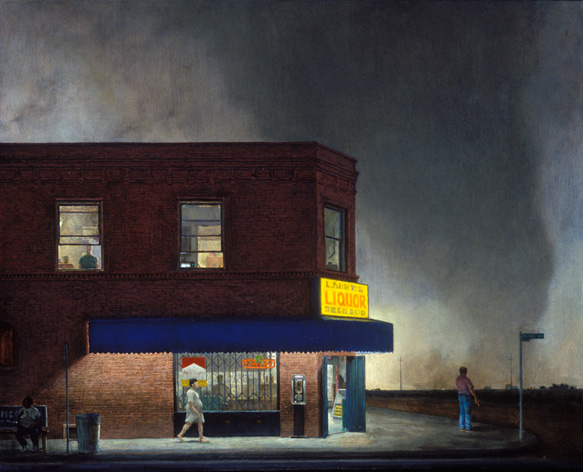
California artist John Brosio has made a specialty of painting tornadoes. They touch down outside of villages in which Edward Hopper might have felt at home. In Brosio's paintings, the incongruence that I spoke of is present, as people seem blithely unaware of what is happening a mile or two away, perhaps not even questioning why their lights shine so brightly in the daytime.

It's hard not to think of tornadoes metaphorically, remembering that God appears as a column of smoke leading the Hebrews through the desert and speaks to Job from the whirlwind. But why stop at metaphor? If global change is right, the earth is trapping too much energy, leaving us with a malevolent force that resides on our landscape whether we notice it or not.

Island 2 by John Brosio, 2002. Click on the picture for a closer look.

Saturday, April 23, 2011

Foul Territory

This week, Major League Baseball Commissioner Bud Selig wrested control of the Los Angeles Dodgers from owner Frank McCourt because of the team's shaky finances occasioned by the latter's messy divorce.

There are many Southern Californians who can't connect with the Dodgers anymore. Indeed, season ticket sales have plunged. The stadium, inconveniently located and poorly designed, has grown old before its time. Its restrooms are vile. Parking and refreshments are priced exorbitantly. Worst of all, the fans have grown crude to the point of wanton violence, as we saw on opening day.

Perhaps the time has come for the Dodgers to find a new stadium, a new owner, and perhaps even a new city. Down the road in Anaheim people watch the Angels in a cleaner and better designed venue that is convenient to the freeway. Parking costs half what the Dodgers charge. Refreshments are far more varied and prices are fair. Most of all, the ambiance is cheerful and family friendly.

If the Dodgers can not provide a safe and clean stadium for an outing at a reasonable price, then both the team and the city might be better off without each other.

Baseball Players Practicing by Thomas Eakins, 1875. I find an industriousness and a brooding quiet in many of Eakins' works. Here, only a handful of spectators, barely sketched, presents no distraction to the players. The crowds will return with their adulation, but in this moment, late in the season and after the game, as evidenced by the yellow turf and long shadows, the athletes are joined in wordless diligence. Click on the picture for a closer look.

Saturday, April 16, 2011

Bully Pulpit

This month, an NBC/Wall Street Journal survey found that while sixty one per cent of us say we want a balanced budget amendment to the Constitution, most of us change our minds once we're told of the personal sacrifices that it would entail. It drops to just twenty seven per cent who still wish to pay the piper.

Ever since Lyndon Johnson's "guns and butter " politics, our leaders have competed to shield us from reality. Nixon cancelled the draft so now only professional soldiers are sent to war--over and over again--while the rest of us are at liberty to pretend the nation is at peace. Congress has repeatedly voted to lower taxes and raise the debt ceiling rather than reconcile our revenues with our expenditures. And leaders who should know better countenance Sophistry in assessing the toll we are exacting upon our environment.

This week President Obama addressed the American budget deficit. I can not fault him for his partisan approach--he was fighting fire with fire. But he needs to mount the bully pulpit and educate the public. I hope that a detailed proposal along with a series of dutch uncle speeches will follow. Obama's tendency to entrust Congressional horse trading will simply not suffice.

"Bully Pulpit", by the way, is a term coined by Theodore Roosevelt. It is well to remember that Roosevelt, a Republican when he was president, was firmly committed to free enterprise. However, he was a trust-buster and the author of the "Square Deal", (precursor of FDR's "New Deal"), which sought to protect workers and to regulate capitalism's excesses.

Official Portrait of President Theodore Roosevelt by John Singer Sargent; 1903. This painting hangs in the White House. The story goes that Sargent and Roosevelt, as they traipsed from room to room looking for the right place and pose, became impatient with each other. While climbing the stairs, the subject gripped the newel post and turned on the painter to express his pique, and Sargent had his pose. Click on the picture for a closer look.

Saturday, April 9, 2011

No posting this week.

Please come back next weekend.

Saturday, April 2, 2011

The Madding Crowd's Ignoble Strife

Two senseless attacks, within hours of each other, 7500 miles apart. A mob of religious fanatics in Afghanistan, incensed over the burning of a Koran by a publicity seeking crackpot in Florida, attacked a United Nations compound, (apparently unable to distinguish the UN from the US), and killed everyone they could lay their hands on. In Los Angeles, two Dodgers fans attacked some Giants fans leaving one in a coma. The Afghanistan incident is not over; there was more violence today. The Los Angeles perpetrators are still at large, but it is likely they will be caught.

Kurt Vonnegut, in his novel Cat's Cradle, gave a name to the false associations people make with one another: granfalloon. The example he gave was "Hoosiers" as if people from Indiana shared some exclusive insight or destiny. Using a Calypso riff, he wrote: "If you wish to study a granfalloon, just remove the skin of a toy balloon." At their most benign, granfalloons are nothing more than fan clubs or Facebook friendships. At their worst, they're mobs.

Among the many features the two current examples have in common is that each dishonors the values the perpetrators claim to espouse. Mob violence is the self-aggrandisement of people who are otherwise empty, insignificant, and impotent.

Hieronymous Bosch felt the same way about the mob that rejoiced in the Crucifixion. How did the death of an obscure rabbi enhance their lives? What wrong were they righting? Bosch painted this scene twice before, but with less vitriol. We don't know much about him or his life, but clearly he was no stranger to cynicism in his later years.

With America at war in three countries that hate us, it's harder not to give in to such cynicism each passing day.

The Carrying of the Cross by Hieronymous Bosch, ca. 1510. Note Saint Veronica holding the cloth bearing Christ's visage. This incident, while not mentioned in the Gospels, is the Sixth Station of the Cross. Veronica, (aka Berenice), wiped the spit and mud from Jesus' face with her veil, cleansing him of the filth and depravity of mankind. Click on the picture for a closer look.

Saturday, March 26, 2011

Winter Light

On paper, it's spring, but we've had snow off and on for a week. No complaint. The transformation of the landscape that I see upon awakening after a night of snowfall is magic, pure and simple. I can no longer ski, so shoveling has become my winter sport of choice. Again, no complaint.

George Wesley Bellows is associated with The Ashcan School of early twentieth century American art. He painted street urchins, derelicts, and teeming slums. I suppose his signature works are his dark paintings of long-limbed prize fighters, battling before louche crowds in smokey air. But there was another side to him--perhaps several other sides. He left the grit of New York City to live in Woodstock where he got back to nature and painted landscapes.

In Love of Winter, the realist turns impressionist. Bellows again depicts a large crowd of people, but out in the open, skating a frozen river beneath blue mountains, and not jammed into a tenement. Their faces are blanks; indeed only two seem to have eyes. But there's energy in their body language, and I don't think it's a stretch to say that some recall to us the sinewy strength of Bellows' boxers.

I don't know the back story. Why are they all skating in the same direction? Are they heading to a winter gathering, where a bonfire and hot chocolate await? Is there a set route for them, like that of a marathon? Or is the artist, a socialist, telling us that in this healthy and natural setting, the progress of humanity is united as opposed to the conflict and chaos of the cities?

Perhaps it's best not to speculate too much. I've done my shoveling for the day.

Love of Winter by George Wesley Bellows, 1914. Click on the picture for a closer look.

Friday, March 18, 2011

Let Us Now Praise Famous Women

This weekend is Purim, the raucous celebration of the deliverance of the Jews from Persian slaughter in Biblical times. The story begins with King Ahasuerus reasserting male dominion over women throughout his vast kingdom, and in his own palace, by issuing a decree and by banishing his recalcitrant queen, Vashti.

The heroine of the tale is Esther, his new queen who hides her Jewish identity. When her people are threatened with genocide, she bravely intervenes. This entails approaching the king unbidden, an act that could cost her life.

The rest you should read for yourself because it's a well constructed short story until the last two chapters where there are textual problems: contradictions, repetitions, and a shift from a celebratory tone ("The Jews had light, and gladness, and joy, and honor") to a vindictive one ("...the other Jews...slew of their foes seventy and five thousand...").

The painting is by another heroine, Artemisia Gentileschi (1593-1656?). She was one of the first woman painters to achieve fame and acceptance in her own time. However, she suffered rape and torture along the way, and was generally deprived of the more lucrative commissions despite her acknowledged skill. Artemisia is a great favorite of feminist art critics, not least because of her many depictions of strong women in conflict with men.

I like this painting because Artemisia has internalized the story. While it is true that Esther makes herself beautiful before approaching the king, it's also true that she fasts for three days beforehand. In Artemisia's interpretation, Esther does not just prostrate herself before the king, but swoons, no doubt from hunger and fear. Her attendants support her tenderly, bound to their queen in sisterhood.

The king is shown as young and handsome. His sympathy is aroused, not his lust. He rises from his throne. Artemisia omits the golden sceptre that he extended for Esther to touch. He is not a frightening figure; she might even love this man. Esther's fear is for her people, rather than for her own life.

Feminist, but still romantic.


Ester e Assuero by Artemisia Gentileschi; ca. 1621-1630. Click on the picture for a closer look.