Weekly musings on the arts and current events.

Wednesday, July 3, 2013

Eschatology


Contemplating the end of days, which may come a billion years from now or perhaps sometime next week, I'm incredulous.  It's not that I can't believe life on earth will cease, but that all our proudest accomplishments will disappear.  Our great works of art, some of which I've written about here, Shakespeare and the King James Bible, the Updike novel I'm going to finish later today, the sound of Mozart, Marilyn's white dress, Judy's ruby slippers, in fact all of our icons will be gone.  I don't expect our architecture to last to the end.  Allowing ruins to stand on precious real estate, like the Forum in Rome, is an anomalous indulgence.  But the memory of our designs and the evolution of our thinking will not abide.  Even if we were to launch Earth's essential data and photo files into space, their context would be gone.  Comprehensible or not, our ideas  would lack all vitality and be gibberish to minds that had never watched a sunset.

Photo of the Upper Geyser Basin region in Yellowstone National Park.  Scientists believe the earth will come to look like this as the aging sun grows hotter and the earth's carbon dioxide is depleted, ironic as both those conditions may sound.  Click on the picture for a closer look or on the link for a brief article.: http://www.dailymail.co.uk/sciencetech/article-2352717/The-end-world-nigh-Scientists-predict-life-wiped-planet-billion-years.html#ixzz2Y0FoMnCA

Saturday, December 31, 2011

About Time and Travel

On this last day of 2011, I am preparing to leave my mountain top for an extended trip abroad, followed, I hope, by further travels in the spring.  The confluence of the New Year and my journeys seems like a natural moment to begin a hiatus from this blog.  Not that writing it is a hardship or terribly time consuming, but I want to clear the way for whatever commands my attention while I'm on the road.

Sometimes I think I'm overly fond of the format of Ars Brevis. A reader sent me a book of his poetry this week in the hope that I'd review it here, but I've never posted book reviews  before and don't know how I'd make one fit.  Perhaps when I return, I'll have some new ideas about form and content.

More people read this blog than I realized.  Google provided me with some figures and I was surprised, especially since very few visitors leave comments.  I suppose if I'm to resume this effort later in the year, I should do something to promote readership and stimulate discussion.

My first trip is to work as a volunteer teacher in Costa Rica.  I was there once before about twenty years ago and am anxious to see how it's changed.  I hope when I return that I'll have some tales to share.  If you'll send me your email, I'll let you know when I get back.  My address is:  talltchr@gmail.com.  And if you haven't already, please friend me on Facebook.

In the meantime, let me wish you a very happy and healthy 2012.

Portrait of a Young Man by Antonello da Messina; circa 1470.  This Sicilian artist's work shows the influence of both Italian painting in its simplicity and Flemish painting in its attention to detail. This portrait, like the Mona Lisa, makes me wonder what put such a wry smile upon this face over five hundred years ago.  It is the wonder of art that from the vantage of our century we can share a moment of mirth with our predecessors of auld lang syne.  Click on the picture for a closer look.


Saturday, December 24, 2011

Santa in Wartime

Our popular image of Santa Claus has evolved over the years primarily through the work of Clement Moore's (possibly plagiarized)1823 poem A Visit From St. Nicholas, the nineteenth century drawings by Thomas Nast for Harper's Weekly, and the twentieth century paintings by Haddon Sundblom for Coca-Cola. The one shown here is the first of Nast's Santas and it was drawn at the request of Abraham Lincoln as a bit of psychological warfare.

 Santa is shown handing out gifts to Union Soldiers and children at a time in the war when the south was blockaded and suffering severe deprivation. There was no question of Confederate children receiving presents that year. Notice the soldier on the left finding a pair of socks in his package--a precious gift indeed for an infantryman. Santa's raiment displays stars and stripes to show where his loyalty lies. He is holding a puppet which is thought to be the effigy of Jefferson Davis with a noose around his neck.

Is it me, or has the Christmas spirit diminished in our time?  I can easily list all the distractions we face: the economy, the war, disasters, and  our especially vituperative political scene.  But something else is missing, and it's not just that there's no hot toy this season or that the Christmas release movies haven't caught on.  As a Jew, it's probably not appropriate for me to criticize, but I feel it nonetheless:  an absence of hope and purpose, a feeling that all we're doing is hanging onto what we've got and defending it against those who are envious.  

 2011 has been a difficult and dispiriting year.  My personal vow is to be of greater service in 2012 and this may impinge upon my ability to maintain this blog's weekly schedule.  Meanwhile, I wish everyone who drops by the happiest of holidays and a new year of restored, if not fulfilled, hope.

Santa Claus by Thomas Nast, 1863.  Nast also created Uncle Sam.  Click on the picture for a closer look.

Saturday, December 17, 2011

Gadfly

One can't speak of a tradition of gadflies because gadflies defy tradition.  Nevertheless, there's a lineage that begins with Socrates (The unexamined life is not worth living.), and continues through Dr. Samuel Johnson (Patriotism is the last refuge of a scoundrel. ),  Jonathan Swift (When a true genius appears in the world, you may know him by this sign, that the dunces are all in confederacy against him.), Mark Twain (If you pick up a starving dog and make him prosperous, he will not bite you.  This is the principle difference between a dog and a man.), George Orwell (In our age there is no such thing as 'keeping out of politics.' All issues are political issues, and politics itself is a mass of lies, evasions, folly, hatred and schizophrenia.),  H.L.Mencken (There is always a well-known solution to every human problem--neat, plausible, and wrong.), and many others.  Now let's add to that list the late Christopher Hitchens whose passing we mourn this week. 

Beware the irrational, however seductive. Shun the 'transcendent' and all who invite you to subordinate or annihilate yourself. Distrust compassion; prefer dignity for yourself and others. Don't be afraid to be thought arrogant or selfish. Picture all experts as if they were mammals. Never be a spectator of unfairness or stupidity. Seek out argument and disputation for their own sake; the grave will supply plenty of time for silence. Suspect your own motives, and all excuses. Do not live for others any more than you would expect others to live for you.

I confess, I haven't read nearly enough of him, but I find his essays irresistible even when they irritate the hell out of me.  Hitchens identified himself as a soixante-huitard, referring to the tumultuous year of 1968 that launched his political voyage, beginning on the left, veering rightward after 9/11, but always sui generis. 

If 1968 was the year of his spiritual birth, how sadly fitting that he should leave us at the end of 2011 which saw a renascence of protest.  After decades of acquiescing,  American youth took to the streets, perhaps in emulation of this year's much larger and more violent upheaval in the Middle East.   In one of his last published essays, Hitchens had this to say about the Arab Spring and the current debate over America's destiny:

It's a strange fact, but in the present political season it is the American Right that seems to harbor the most skepticism about American power. I find this odd: Yet again the US has managed to get itself largely on the right side of a massive historical shift -- the Arab Spring, which it had not "read" very well the first time round. And yet, most of the remarks made by seekers of the Republican nomination have been sour or grudging.

...The ancients taught us to fear hubris, and the Bible teaches the sin of pride. I am always amazed that American conservatives are not more suspicious of self-proclaimed historical uniqueness. But proclaim it they do, as if trying to reassure themselves against the blasts of what looks like a very bad season.


Christopher Hitchens, illustration by Edward Sorel. The artist, a prolific caricaturist, has been honored by the Freedom From Religion Foundation,  Click on the picture for a closer look.

Saturday, December 10, 2011

The Weekends Before Christmas

As a teacher, I rarely got to go to elaborate office parties. Ours tended to be homely on-campus affairs catered by a low bid Mexican restaurant whose tamales and enchiladas were crunchy at the bottom but ominously cool in the middle. There was, of course, no alcohol served, which made the principal's long iteration of thanks to those who helped deck the cafeteria all the more insufferable. My friend, the music director, was always shamed into performing gratis, and each year it burned him when his students had to sing over loud conversations. Once they changed the celebrations from a luncheon to a pre-school breakfast, I stopped going.


Nothing like the lavish party by a dot.com company that I attended before the tech bubble burst. It was held at a yacht club, and a large cabin cruiser took us in groups of thirty for rides around Marina Del Rey. The food was sumptuous and the liquor flowed. The fun of the evening, for me, was to watch geeky engineers get tipsy and apply their considerable intellects to making merry. Unfortunately, within a year, nearly all of them had lost their jobs.


Christmas parties haven't always enjoyed a good reputation. We recall their raucity when we sing about winter wassailing:

Wassail, wassail, all over the town.

The cup, it is white and the ale, it is brown.

The cup, it is made of the good ashen tree

And so is the malt of the finest barley.

There was often brawling and mischief, and by Christmas morning, the jails were filled. It was not commercialism that first profaned the season's sanctity.


What to make of this antic 18th Century painting? Thirteen women, the same number as attended the Last Supper, are seen in various states of inebriation. Two are fighting, several are toasting and guzzling, and one appears to have descended into lascivious reverie. The woman with the crucifix around her neck vomits on the one who has passed out on the floor. The two in the center have a more serious mien, perhaps engaging in earnest character assassination while they continue to dip into the bowl. Like Christmas wassails, there is something ironic in the revelers' depravity. After all, they're well dressed, the setting is luxurious, with a male servant peeking in at the door, and whatever the holiday or occasion it might be, we doubt they intended for it to get this way.

A Midnight Modern Conversation, an anonymous 18th Century oil painting in the style of William Hogarth. Click on the picture for a closer look.

Saturday, December 3, 2011

Bon Voyage


As the detritus ofthe 99% occupations is swept into dumpsters, the movement appears to be sinking. No leadership or agenda emerged during the protests. Quite the contrary, the occupiers seemed to lose sightof their broader goals, and let the symbolism of seizing public parks become their actual and only consensual objective.

We also learned this week that the Tea Party's popularity has ebbed and that the sixty Congressmen who identify with it may have a hard time getting reelected. The public has as dim a view of the Republican party as they do of the Democrats in the wake of a shamefully stalemated and ineffectual first session of the 112th Congress.

Meanwhile, the wayward course of the Republican Presidential race continues to reveal that the Grand Old Party is adrift. Herman Cain's support in Florida plunged from thirty four per cent to just ten in less than a month. His pitch about being an outsider and a non-politician was catchy, but now the limelight is on Newt Gingrich, the consummate Beltway insider and backroom fixer. Newt's ascendancy has energized the campaign of Ron Paul who despises Gingrich and is eagerly attacking him.

This all has the feel of the end of a cruise, when newly bonded passengers and shipboard lovers make earnest pledges to stay in touch but then don't even bother to send each other copies of their snapshots. We're just along for the ride and when the ship stops, we disembark as fast as we can.

The fact is that no candidate or movement today is realistically addressing America's challenges, all of which are international in scope. That's why the campaigns and movements that break in and out of the news have an air of unreality to them. Passionate fools lay the blame for whatever they don't like at the feet of easy targets: rich people, liberals, Muslims, illegal aliens, gays, abortionists, pot growers, George W. Bush, Barack Obama, etc. Politicians try to shield the populace from all unpleasantness: taxation, war, and the changes demanded of us over time.

The minority in the middle stands ready to support a leader who will eschew blame and chart a course of responsibility and sacrifice. We've been waiting a long time for such a favorable tide.


Poster of the Oranje by Jean Walther, 1939. This beautiful Dutch ship did not need to be repainted when it was pressed into service as a floating hospital during World War II. After the war, it was renamed the Angelina Lauro and saw long service as a cruise ship until a galley fire destroyed it. Her sister ship, the Achille Lauro, was hijacked by Palestinian terrorists in 1985. Click on the picture for a closer look.

Saturday, November 26, 2011

No posting this week

I'm part of the throng that's jamming the freeways on this holiday weekend. Please come back next week.

Saturday, November 19, 2011

Autumnal Reflections

Autumn at its most stark. My mountain has been visited by a frigid cloud and I can't see farther than a tree or two past my property line. The black oaks' leaves are yellow and they alone find something to glimmer about in the subdued morning light. Our October snow was untimely and warm days followed and melted it, but now there's no question that winter is nigh.

Thanksgiving is a harvest holiday and those are always the best. Traditionally, grain bins and smokehouses are full, the weather is not yet forbidding, and memories of summer are still fresh; indeed my tan hasn't fully faded. After Thanksgiving come the Winter Solstice holidays: Christmas, New Years, Hanukah, and Kwanza, and they'll be observed around fireplaces and with candles and colored lights. But today, it is the autumn leaves that blaze.

It is my custom at this time of year to reflect with gratitude upon my life, my family, my friends, and upon the state of the world. In this space, I've written before that I find hope in the fact that our dire economic straits are distributional and not born of famine, disease, pestilence, or want. We have food, energy, products, markets, and capital. We just need to learn to manage them better.

In the Bible, the first commandment given by God after finishing His creation is: "Be fruitful and multiply, replenish the earth, and subdue it." Thanksgiving should make us ponder how well or ill we are carrying out our charge.


Autumn Hills & My Studio by Robert Vonnoh (1858-1933). I don't know much about the artist other than that he was an avid student of French Impressionism, a beloved teacher in the US, and said to be of a gentle and melancholy disposition--a man who liked nothing more than to set up his easel in the open air. In short, a man of autumnal temperament. Click on the picture for a closer look.

Saturday, November 12, 2011

No Posting This Week

My motherboard bit the dust and now I'm consumed with recovering and reinstalling. Please come back next week.

Saturday, November 5, 2011

The Not-So-Silly Season

One year from now we will be voting for President. I'm reluctant to write another word.

There may have been a time that I looked forward to national races, but I can't recall when. We have a full year of punditry and predictions to look forward to, together with equivocations, clarifications, and gaffes--and all done in deadly earnest.

We'll no doubt witness a blizzard of attacks and allegations, and quite possibly an October surprise or two. It will fall to the vice-presidential candidates to cast the biggest and sharpest stones. The heads of the tickets will try to defend themselves, and defame their opponents, while still looking presidential. Absent a quick wit, it won't be a pretty sight.

And when all is said and done, very little of it will matter. Regardless of the winner, Washington will return to its horse trading over half measures.

In the past month, we've seen two Republican frontrunners rise and fall due to their vanity and ineptitude. Rick Perry wasn't prepared to debate the issues or defend his record, and Herman Cain wasn't up to scrutiny of either his policies or his character. Neither has exhibited any grasp of how complicated the world is or how far reaching a chief executive's curiosity ought to be. Perry announced a hastily conceived flat tax proposal that even conservative economists denounced as nonsense. Cain, losing his sense of humor and bonhomie, has resorted to barking at reporters, inventing strange facts about China, deriding the importance of foreign policy, and blaming Perry for spilling the beans about his harassment of female former employees.

Obama got in trouble last week when he made a joke at President Sarkozy's expense, so we may not be hearing anything funny from him again. Mitt Romney has never gotten a laugh in his life. Will no one save us from this impending gloom?


James Madison by Gilbert Stuart, 1804. Stuart painted the first six Presidents, including the Washington on our dollar bill, plus a thousand other American faces. The statesmen all appear formal and cerebral, reminding us that the United States did not begin as a populist democracy, but as a republic in the hands of an intellectual elite. Stuart himself was said to be an engaging personality who amused those who sat for him. What a waste that he didn't paint the smiles that he had evoked. Click on the picture for a closer look.

Saturday, October 29, 2011

Night of the Living Chocolates


Sometimes we fly into the maw of our fears. On Halloween, we masquerade as demons. At the movies, we cry "Bring it" to those that would frighten us. And then there's trick-or-treating, when we let children forget everything we've taught them about candy from strangers.

The story of Hansel and Gretel is for a different time of year. The gingerbread home, bedecked with chocolates, sugared fruits, marzipan, and penny candies, wherein resides a cannibalistic witch, is a fine cautionary, but not for the night of October 31st. On All Hallows Eve, the kids walk right up and ring the bell, take whatever treats are offered, and soap the windows of old fools who won't come to the door.

Of course, each year the urban legends are rehearsed: razor blades in apples, maraschino cherries laced with LSD, and now, perhaps, counterfeit candy from China sweetened with anti-freeze (I made that one up). Even though the stories never pan out, they belong to the scary lore of Halloween. My uncle used to say he was going to pass out plastic bags to the kids, but he never did it.

I've saved up quarters this year in lieu of treats as I no longer allow chocolate into the house. I've also refused an invitation to watch football Monday night because I feel it's my duty to be home when the wandering sprites and neighboring goblins come to call.

Peddlers are extinct. Door to door Christmas Caroling has all but died out in the cities. Halloween is the only time I can think of when a stranger's knock is a welcome event. I wouldn't miss it for the world.


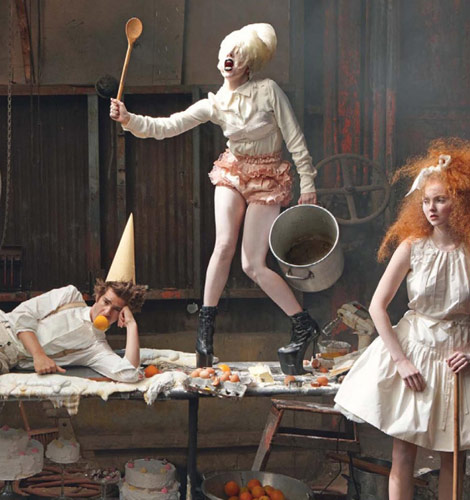
Hansel and Gretel in a scene staged by Grace Coddington and photographed by Annie Leibovitz for Vogue, 2009. The witch is Lady Gaga whose excellent duet with Tony Bennett, The Lady is a Tramp, was released this month. Click on the picture for a closer look, and Happy Halloween.

Saturday, October 22, 2011

No posting this week.

Please come back next week for a Halloween posting.

Saturday, October 15, 2011

Burning Issues


Religion rears its ugly head. In Egypt, Muslims have attacked Coptic Christians. And when the latter demonstrated peacefully in protest, elements of Egypt's military regime attacked them again. In Libya, a Jew returning from twenty years of exile to restore a synagogue, was assaulted and driven back into exile. The Arab Spring, with its hoped for flowering of democracy, is fast descending into an orgy of intolerance.

In America, the Perry campaign has kicked over a rock. Governor Rick Perry is the most overtly Evangelical of the candidates and his supporters have been pounding the pulpits. Mrs. Perry disingenuously deflected criticism of his poor debate performances by claiming he'd been "brutalized" for his faith. Worse still was a Perry camp bigot, Robert Jeffress, who attacked Governor Mitt Romney's Mormon faith as an unchristian cult. The remarks of neither have been repudiated by the candidate.

There remains the controversy over whether America is a Christian country. It is an argument that will never be resolved and won't go away. People are free to vote by any criterion they choose, and there will always be candidates who appeal to religious affinity. But publicly avowing that only a Christian is qualified to lead this nation is bitterly offensive to any who value the Constitution's unique contribution to history.

However, we can not deny that religion has a role. It does no good to weigh the brutality and injustice that it has caused through the ages because we can not fairly assess the good that faith has done, and still does, everyday. In Egypt, some of those who tried to protect the Coptic Christians in the streets were Muslims. And those of us who support Israel as a Jewish state, even though we may be secularists, do so because it is unrealistic to think the rights of Jews in that region would be respected in any other way.

Let us pray for the day when religion once again becomes a private matter between individuals and their Creator.

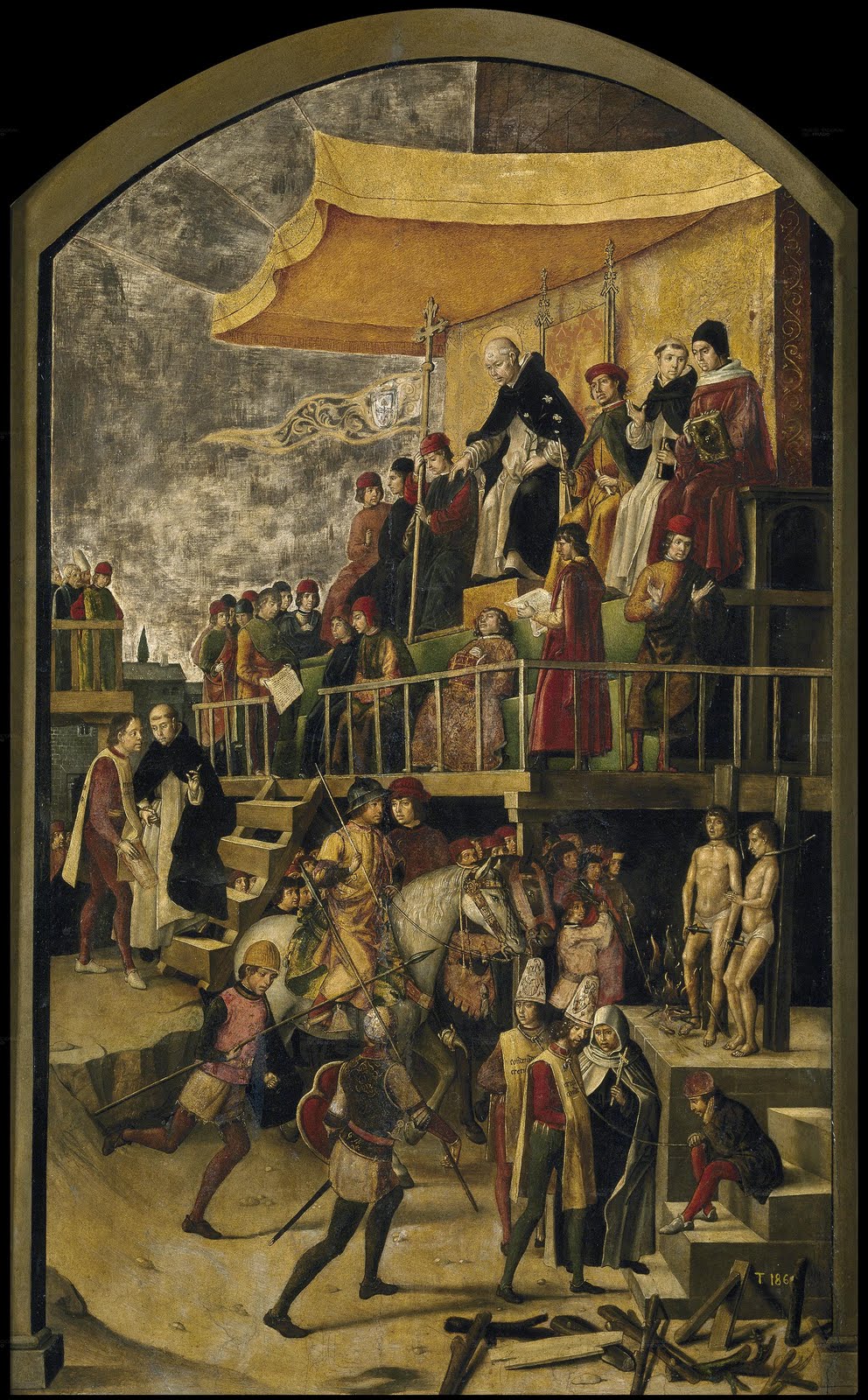
Saint Dominic Presiding Over an Auto De Fe by Pedro Berruguete, 1475. The scene is slightly anachronistic since Dominic died ten years before the Inquisition began. However the order he founded, the Dominicans, was put in charge of the slaughter in Spain, and besides, Dominic murdered many a heretic in France in his time. It's my opinion that the Inquisition depleted Spanish culture permanently, consuming it with hatred while the rest of Europe was engaged in the Renaissance. Click on the picture for a closer look.

Saturday, October 8, 2011

Two Wars, One Struggle

Occupy Wall Street continues and is spreading to other cities. The press has elevated it from a local act of civil disobedience to an inchoate national movement. Pundits now wonder aloud if this isn't the start of a force to countermand the Tea Party. Older pundits have likened the current protest's style and ambiance to that of Viet Nam era demonstrations at their naughtiest, with counter-culture exhibitionists hogging the spotlight but speaking gibberish in front of microphones.

It all feels much too familiar.

I've attended Tea Party rallies and been struck by the number of senior citizens who apparently haven't considered the implications of their fiscal demands vis a vis their Medicare and Social Security payments. Many have a strong religious and rural orientation and seem to identify the liberal policies they condemn with the depravities of urban life. In other words, the Tea Party wages the latest assault in the cultural warfare that has riven America since the 1960's.

The Occupy Wall Street movement, on the other hand, strikes a blow for class warfare. America is drifting dangerously toward plutocracy as the discrepancy between rich and poor, and the disappearance of those in the middle, makes our country look more and more like pre-revolutionary France.

I'm not the first to observe that the class warriors and the cultural warriors have much more in common than they care to admit. Both sides sound the alarm that middle class life in America is grievously threatened. Both demand justice and accountability. If only they could speak to each other without shibboleths and slogans. If only they didn't look at compromise and bipartisanship as perfidy. If only they didn't drag in social issues.

If only they haven't hated each other for years.


Hair lithograph, 1968. The musical was aptly named: "The American Tribal Love-Rock Musical". For a decade, reproductions of this crude image on posters and record albums, with the green print on a green field, were ubiquitous. But the play never rose above maudlin in addressing the Viet Nam War, while it smugly edified its tribe, i.e. the youthful audience. The revived show that opened in 2009, I've heard, emphasizes the characters' adolescent angst over their social rebellion. Click on the picture for a closer look.

Saturday, October 1, 2011

Casting Without a Hook

Thursday was Rosh Hashanah, the Jewish New Year. On the Hebrew calendar, this is 5772. Part of the afternoon observance is a service called Tashlikh which means to cast away. This is performed at a body of water where there are fish: in my case, Big Bear Lake. After a few prayers and meditations, the participants shake bread crumbs out of their pockets and into the water, symbolically casting away their sins for the fish to eat and bear away.

The observance is not set in stone. Rabbis have debated over the ages how, why, and even whether it is to be performed. Some have suggested it is a pagan rite to bribe the devil that resides in the deep. Others compare it to the scapegoat symbolism. Another view is to remind us that people are like fish: easily ensnared.

I had never attended a Tashlikh service before. This one, conducted on two pontoon boats tied to a fishing buoy, did not disappoint. I especially liked the liturgy, which was introspective rather than legalistic. In other words, the sins that were named are not civil offenses, but lapses in character. A sampling:

Let us cast away the sin of Deception, so that we will mislead no one in word or deed, or pretend to be what we are not….
Vain ambition, which prompts us to strive for goals which bring neither true fulfillment nor genuine contentment...
Stubbornness...Envy...Selfishness, which keeps us from enriching our lives through wider concerns, sharing, and reaching out in love...
Indifference…Pride and Arrogance.


The brilliant sky, glistening water, and late afternoon sun beat heck out of the drone of prayers in the synagogue.

Noboru Koi Large Fortune by Wu Jin Sato, a contemporary Japanese commercial artist. Paintings and prints like this are valued as apotropaic charms to ward off evil and attract good luck. Click on the picture for a closer look.

Saturday, September 24, 2011

Another World

Around the turn of the century, the last century that is, the Cornish art colony in upper New Hampshire thrived. About eighty artists and notables were associated with this retreat, which was more or less organized by the sculptor Augustus Saint-Gaudens and the painter Thomas Wilmer Dewing. First artists and architects, next writers, and then other talented and accomplished people, along with the merely wealthy, took up residence in and around Cornish and Plainfield, New Hampshire, for either the summers or year round. The list of colonists include Maxfield Parrish, Ethel Barrymore, Marie Dressler, Isadora Duncan, Frederic Remington, Daniel Chester French (sculptor of the Lincoln Memorial), legendary editor Maxwell Perkins, Judge Learned Hand, and President Woodrow Wilson.

These were not starving artists. Their presence revived the economy of this formerly hardscrabble farming area. Many built stunning residences with formal gardens, including ten designed by colonist Charles A. Platt that show Georgian and Italian Renaissance influences. Others remodeled existing farmhouses in high style.

I'm curious about how active and inclusive their social gatherings were. It was never a teaching colony, but they must have held parties and picnics, gallery openings, lectures, concerts, and the like. Was Jewish sculptor William Zorach always invited? I'm sure there were also intrigues, liaisons, fallings-out, rivalries, and many drinking bouts. Perhaps there's a historical novel lying in wait for a writer willing to do the research.

This painting, Symphony in Green and Gold by Thomas Wilmer Dewing, 1900, was inspired by one of the colony's amateur theatricals, staged in a garden and illuminated by Chinese lanterns. If I have any fantasy about living in such a colony, it is of being culturally self-sufficient, participating in do-it-yourself entertainments alongside creative people. Click on the picture for a closer look.


Saturday, September 17, 2011

Late Summer

There's something defeatist in the prompt drydocking of the speedboats on my mountain lake. Labor Day has passed, but we have one final weekend of summer, and besides, it won't get cold for many more weeks, barring a precipitous snowfall. Can't we pretend it's summer for just a bit longer?

But the fireplaces are already ablaze, and while the mornings may not bite the earlobes just yet, there is a new insistence to the breeze that it be respected with a sweater. For the first time in many months, I am craving a bowl of soup.

Never mind. Everyone says they like autumn best, if for no other reason than because it's the time when they can layer their apparel with soft fabrics and earthy colors.

John Singer Sargent painted his friends Paul and Alice Helleu while visiting an artists' colony in the Cotswolds, a range of hills in England. I like this scene very much, with the top of Paul's straw hat as a surrogate for the sun--see how the light seems to radiate from it in the grass above--even though her straw bonnet is actually a bit brighter. Alice's evident boredom with her husband's absorption in his work, on what surely should have been an afternoon of fishing and recreation, gives a comic cast to a very intricate composition.

I can't help imagining the full scene, with Sargent positioned at our vantage, working on this painting. What must the sounds have been like, the birds, breeze and water mixed with the scrape of the brushes against the two canvases, and perhaps Alice humming softly to herself?


An Out-of-Doors Study by John Singer Sargent, 1889. Click on the picture for a closer look.

Saturday, September 10, 2011

Nine Eleven


Everywhere people are remembering where they were on this day ten years ago. It's easy to recall how we first heard the news, but harder to think of where we were as a nation before the Twin Towers, before the second Iraq war, before the Afghanistan adventure, before our crushing budget deficits, before a six fold increase in the price of gold, before the Tsunami, before the near sinking of New Orleans, before the ascendency of Barack Obama, before the Tea Party, before this year's unprecedented string of weather related emergencies and disasters, and most of all, before the rise and fall of America's good name in the hearts of our allies all over the world.

Some things only seem new. Our disgust with Congress may be peaking, but I found kindred skepticism the other night when I watched the 1939 film Mr. Smith Goes to Washington. Worry over the national debt has been with us ever since "that man", Franklin Delano Roosevelt, sought to combat joblessness with public works projects. And wars of choice didn't begin with George W. Bush--"Remember the Maine!"

We have felt despair before; is it worse now? What would combat it? I see three potential sources of hope. The first is dialogue. Yes, TV pundits are abrasive, and many people believe harebrained conspiracy theories rather than reputable news sources, but as we approach the next election, I think we can expect a greater audience for the exchange of political ideas and information than ever before. What will result? I have no idea, but my hope is that we will reach a consensus, or as politicians like to call it, a mandate that will enable us to effect changes.

The second is an economic rebound. The financial markets have been fluctuating by as much as 3% in a day, which is distressing. However, the fact that good news causes rallies, however short lived, is evidence of dormant faith in our economic potential. The capital is there, looking for opportunity, and the demand for our goods and services, both here and abroad, is enormous. Our economic downturn is not born of want. This gives me hope.

My third wellspring is more reflective. Our continent is truly blessed, our values are the world's highest, and our society is the most admired. We don't always respect our environment as we should, or live up to what we profess, but I place my hope in our desire to retain our leadership role. In other words, I place my hope in the fact that Americans are not given to despair.


Map, by Jasper Johns, 1961. Johns is a much heralded artist and a gray eminence among the New York art scene. Barack Obama awarded him the Medal of Freedom earlier this year. His most famous works are of the American Flag. I find his work coy, patriotic in one context and ironic in the next. Click on the picture for a closer look.

Saturday, September 3, 2011

Labor Day

It's happened again. I got into a conversation with a conservative friend and found myself defending labor unions. To his credit, my friend conceded that unions were necessary in the last century to defend workers from oppressive corporations. But today, he says, they only seek to coddle the lazy and prevent social and economic progress.

Gently, I tried to remind him that unions were a partner during America's most robust growth years. Today, they're a shadow of what they were while growth has all but stopped. Of course, the unions my friend has in mind are of public servants, and specifically the teachers' unions. In fairness, conservatives don't wish to see robust growth in this sector.

My friend has seen On the Waterfront and a host of other accounts, factual and fictional, of labor racketeering. I suggested that those days are gone and that the big time corruption nowadays is to be found on Wall Street and among its D.C. enablers.

This weekend is called Labor Day, but who remembers why? Certainly not the governor of Texas who has questioned the constitutionality of child labor restrictions. Nor the average worker, 88% of whom are not unionized. Most school children could not recall organized labor's contributions to American history which are all but omitted from today's textbooks.

Perhaps unions can only thrive in a growing economy. When job creation is at zero, as in the U.S. today, there can be no leverage for collective bargaining. So Labor Day is now a relic from a bygone era, a souvenir of America's faded industrial glory.


Lee J. Cobb, Marlon Brando, and Rod Steiger in On the Waterfront, 1954. Arthur Miller wrote the original screenplay and gave it to Elia Kazan, who had directed Death of a Salesman on Broadway. But Columbia's Harry Cohen thought Miller was a communist and replaced him with Budd Schulberg. Kazan, Schulberg, and Cobb (the original Willy Loman) were all friendly witnesses before the House Unamerican Activities Committee and the film is widely seen as a defense of their naming names. Cobb's testimony all but ruined the acting career of my beloved friend and teacher, Jeff Corey, who nevertheless attended Cobb's funeral and made peace with his daughter. Click on the picture for a closer look.


Saturday, August 27, 2011

Syriana


Remember in The Godfather how young Michael Corleone first appears, a dignified and principled Army captain who disdains the workings of the Cosa Nostra? But when his family is threatened, Michael transforms into a ruthless Mafia don with a code of honor that, for all its rituals and sanctimony, is chaotic and evil.

A similar character-driven drama is playing out in Syria where the son and heir of the monstrous Hafez al-Assad has followed in his father's footsteps, murdering over two thousand peaceful protesters to keep his grip on power. This same young man, Bashar al-Assad, once promised reform and freedom in his country. Returning from England, where he studied ophthalmology, he briefly encouraged a free press and countenanced dissenting voices. Bashar befriended the popular Syrian political cartoonist Ali Farzat, attending a gallery opening of a collection of his gently satirical works. He expressed admiration and encouraged their publication in a new magazine...for a little while.

Bashar either changed or he dropped his façade. Everyday we read of further atrocities in Syria's streets at his behest.


The cartoons here are by Ali Farzat. The one on top is from 2007 and states a universal truth about the alacrity with which nations go to war. Last Thursday, Assad's thugs kidnapped Farzat, beat him brutally, and broke his hands. But earlier today he seems to have overcome his injuries and sketched himself in his hospital bed. Click on the picture for a closer look at his gesture of defiance. Also, more of his work is displayed on his Facebook page, but the captions are in Arabic.